How many calories do triathletes need? Why the target changes every training day
A triathlete training 8-10 hours a week typically needs 3,000-4,500 kcal on heavy training days and 2,200-2,800 on rest days. The right number depends on body weight, age, sex, training load, and your goal. Here is how PulseLab calculates it.
By PulseLab ·
A triathlete training 8-10 hours a week typically needs between 3,000 and 4,500 kcal on heavy training days, dropping to 2,200-2,800 on rest days. The right number depends on your weight, age, sex, what you did that day, and what you are trying to achieve.
Most fitness apps ignore all of that. They give you a flat calorie goal. 2,200 kcal, set at onboarding, never updated. That number doesn't know you ran 18km this morning or that you're six weeks from your A race.

Your basal metabolic rate
BMR is the floor: the calories your body burns at rest, before any training is counted. PulseLab uses the Mifflin-St Jeor equation, the most validated formula for active adults:
Male: (10 x weight in kg) + (6.25 x height in cm) - (5 x age) + 5 Female: (10 x weight in kg) + (6.25 x height in cm) - (5 x age) - 161
Age matters here. So does the gap between a 65kg and 85kg athlete. The old model used neither.
Physical activity level
Multiply BMR by a Physical Activity Level factor and you have TDEE. PulseLab derives PAL from weekly training hours rather than a coarse dropdown:
Under 3 hours/week: 1.375. 3-6 hours: 1.55. 6-10 hours: 1.725. Over 10 hours: 1.9.
TDEE is your baseline daily burn, averaged across the week, before today's session is factored in.
Today's training
TDEE averages across the whole week. On days you actually train, the target goes up. Same-day workout burn gets added on top, using MET values from the ACSM Compendium of Physical Activities: running (9.8), cycling (8.0), swimming (8.3), strength work (5.0). If your session logged calories directly, those override the estimate.
A 70kg athlete running 75 minutes adds roughly 855 kcal to the day's target. That changes what "eating well" actually means for dinner.
Your goal changes the number
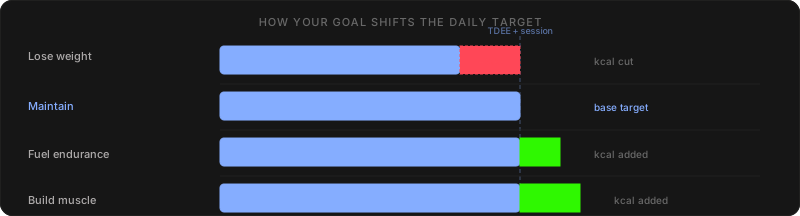
On top of TDEE and workout burn, a goal offset gets applied:
Lose weight: minus 300 kcal. Maintain and perform: no change. Fuel endurance: plus 200. Build muscle: plus 300.
Take a 70kg male athlete, 32 years old, 178cm tall, training 8 hours a week, with a 75-minute run logged. BMR is around 1,787 kcal. TDEE is around 3,084. Add the run, set the goal to endurance fuelling, and the daily target exceeds 4,100 kcal. Nowhere near 2,200.
The floor that protects you
LEA stands for Low Energy Availability. Research by Mountjoy et al. published in the British Journal of Sports Medicine (2014) found that athletes eating below 30 kcal per kg of fat-free mass per day develop measurable physiological consequences: hormonal disruption, reduced bone density, weakened immune function, impaired recovery. The condition, RED-S (Relative Energy Deficiency in Sport), affects both female and male athletes, and its early stages are often invisible.
No goal setting in PulseLab can push your target below this threshold. If "lose weight" would take you under the LEA floor, the target gets raised. The absolute minimum is 1,600 kcal for female athletes and 1,800 for male athletes regardless of what the goal offset produces. You pick the direction you want to go. PulseLab makes sure the number doesn't quietly do harm.
How the score is calculated
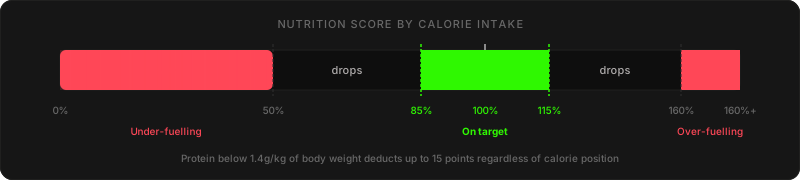
Nothing logged: nutrition score is 70, neutral. You don't get penalised for not tracking. Log 85-115% of your target and the score is 100. Drop below 85% and it falls linearly toward zero at 50% of target. Eat significantly more than 115% and it drops the other direction, reaching zero at 160%.
There is also a protein check. Endurance athletes need at least 1.4g of protein per kg of body weight to preserve muscle during heavy training. If your logged food falls short, the score takes up to a 15-point penalty. It shows up in your PULSE Score breakdown so you can see what's pulling it down.
Nutrition feeds into PULSE Score at 10% weight, same as your training streak and below sleep or HRV. It's not the main driver. But it's calculated properly now, not approximated.